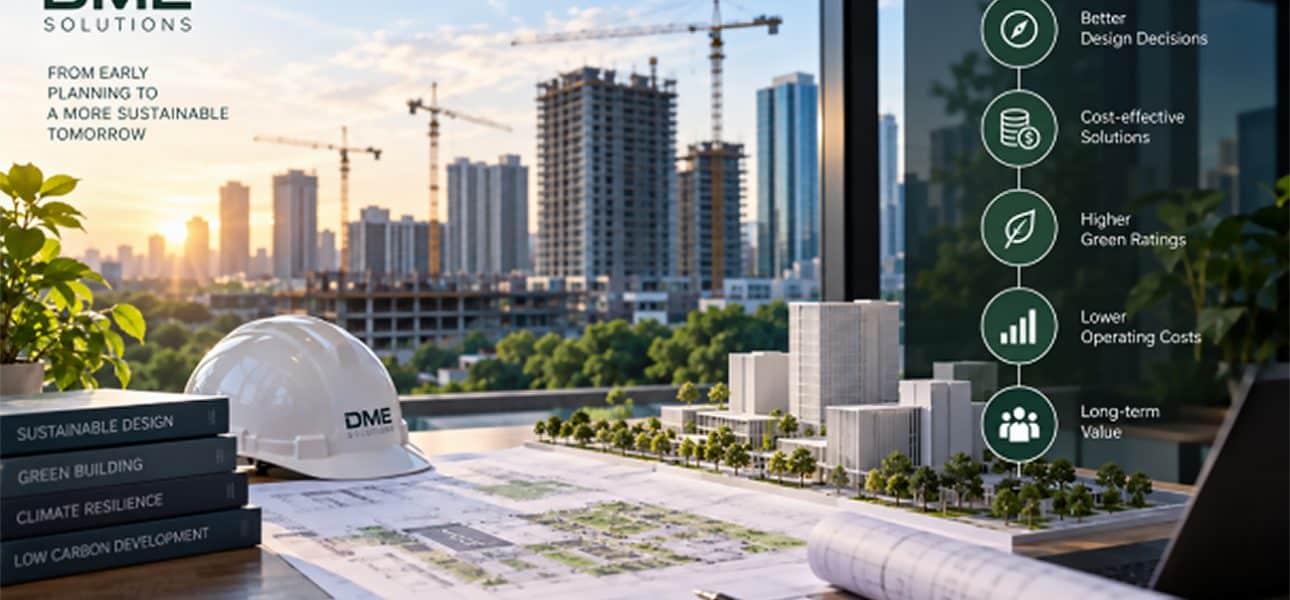
Some of the most effective sustainability decisions are also the simplest — provided they are made early enough.
Building orientation, façade design, glazing, shading, air-conditioning strategy, lighting and landscape can all influence environmental performance long before construction begins.
At DME Solutions, our experience across a wide range of developments has reinforced one important lesson:
It is usually easier and more cost-effective to design sustainability into a project than to add it later.
- More Opportunities, Less Rectification
During concept and schematic design, projects still have flexibility.
A façade can be optimised. Glazing performance can be reviewed. Energy targets can influence M&E design. Sustainability requirements can be incorporated into specifications before tender.
Once construction progresses, those same decisions become increasingly difficult to change.
Early engagement therefore gives the sustainability consultant and design team more opportunities to achieve the required performance through optimisation rather than rectification.
- Establish the Green Certification Strategy Early
Projects targeting GreenRE, GBI, LEED, EDGE, MyCREST or other certification frameworks should understand the requirements before major design decisions are locked in.
Not every sustainability credit has the same cost, complexity or benefit.
DME Solutions evaluates the available pathways and works with the project team to establish a practical strategy towards the targeted rating.
Our objective is not simply to pursue as many points as possible.
It is to identify an appropriate route towards the target while considering performance, cost, constructability and project requirements.
- Sustainability Is Multidisciplinary
No single consultant controls a building’s green performance.
Architecture affects solar heat gain and daylight. Mechanical systems affect energy consumption. Electrical design affects lighting and controls. Landscape affects the heat island, water use and biodiversity. Material selection can influence embodied carbon and indoor environmental quality.
This is why sustainability needs coordination.
DME Solutions’ multidisciplinary approach lets teams consider sustainability requirements across the project, not in individual silos.
- Avoid Expensive Late Changes
Consider something as simple as glazing.
Reviewing its performance before specification may involve a calculation and discussion with the design team.
Discovering during a later assessment that the selected glazing prevents the project from achieving its energy target can have much greater consequences.
The same applies to chillers, air-conditioning systems, lighting, metering, water fittings and other equipment.
Early sustainability input helps reduce these risks.
- Beyond Compliance
At DME Solutions, we believe sustainability should go beyond meeting minimum requirements.
Where practical, the process should also identify opportunities for lower operating costs, reduced carbon emissions, better environmental performance and greater long-term value.
This is consistent with our wider purpose to Decarbonise, Manage and Empower.
- The Best Time to Start Is Early
No single stage is perfect for every project, but earlier engagement generally provides more flexibility.
For Malaysian developers considering sustainability, green certification or decarbonisation targets, involving the sustainability consultant during the planning and design stages can provide a clearer pathway and reduce unnecessary complications later.
DME Solutions brings together regional experience, international standards and science-driven analysis to help project teams make those decisions with confidence.
Global Reach. Local Impact.
- Frequently Asked Questions (FAQs)
Q: How much does a sustainability consultant cost?
A: Fees vary depending on the project’s size, scope, certification requirements and level of consultancy support required.
Q: What is the difference between a sustainability consultant and an environmental consultant?
A: A sustainability consultant focuses broadly on environmental performance, resource efficiency, carbon reduction and sustainable development, while environmental consultants may focus on specific environmental assessments and regulatory requirements.
Q: What qualifications should a sustainability consultant have?
A: Look for relevant industry experience, knowledge of recognised sustainability standards and certifications, and experience working with architects, engineers and developers.
Q: Can sustainability consultants work with existing buildings?
A: Yes. Consultants can assess existing buildings and identify opportunities to improve energy efficiency, water use, carbon performance and overall environmental performance.
Q: What are the benefits of sustainable building design?
A: Sustainable design can help improve resource efficiency, reduce environmental impact, support regulatory or certification goals and potentially lower long-term operating costs.
Engaging a sustainability consultant early gives developers more opportunities to improve performance, manage costs and avoid late-stage changes. By integrating sustainability into the design process from the beginning, projects can move beyond compliance towards measurable long-term value.
Planning a new development or looking to improve its sustainability performance? DME Solutions helps developers integrate sustainability, green certification and decarbonisation strategies from the early stages of a project. Contact DME Solutions to explore a practical sustainability strategy for your next development.